Genes and chromosomes
Gene
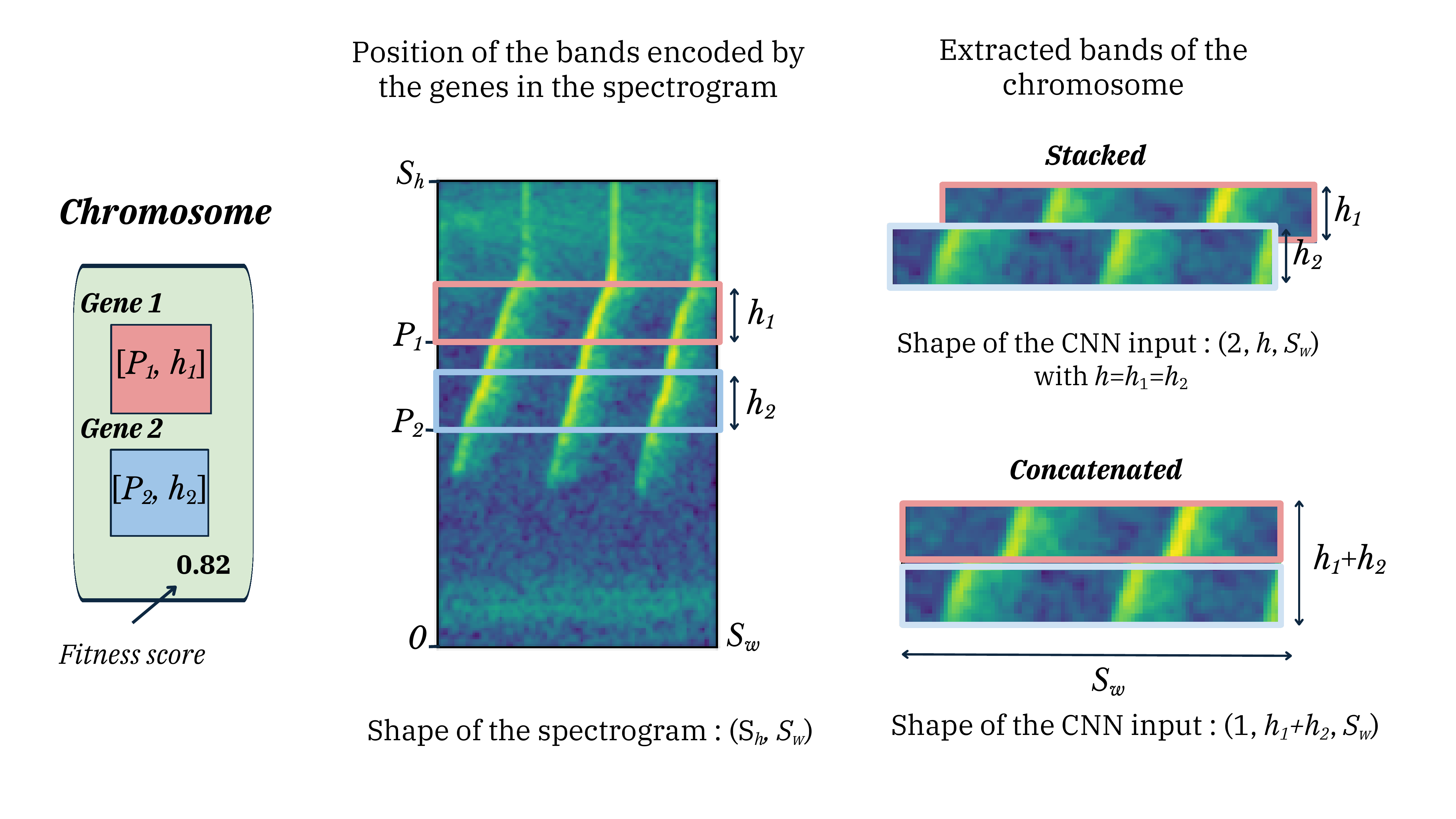
A gene encodes a single horizontal band of a mel-spectrogram. It is defined by two parameters: the lower frequency boundary \(P_k\) and the height \(h_k\) of the band, where \(k\) indexes the gene inside its chromosome.
The position is bounded by the spectrogram height \(S_h\).
A gene carries no model weights. It is a pointer to a stripe of the mel-spectrogram.
In code:
from eso.ga.gene import Gene

gene = Gene(position=42, height=10, image_shape=(128, 256))
gene.get_band_position()  # 42
gene.get_band_height()    # 10
Constraints
Initialisation is constrained by GeneConfig. The bounds determine how exploratory the search is.
| Field | Meaning |
|---|---|
min_position, max_position |
Bounds on \(P_k\). max_position = -1 means the spectrogram height. |
min_height, max_height |
Bounds on \(h_k\). |
band_height |
Fix \(h_k\) to a single value for every gene. Use -1 to disable. |
band_position |
Fix \(P_k\) to a single value for every gene. Use -1 to disable. |
Fixing height gives the chromosome's stacked input a constant shape.
Chromosome
A chromosome holds one or more genes. The number of genes can be fixed or sampled in a user-defined range, controlled by ChromosomeConfig.
from eso.ga.chromosome import Chromosome

chromo = Chromosome(genes=[...], config=chromosome_config, data=data)
chromo.train()
chromo.get_fitness()  # composite: F1 vs. baseline and parameter count vs. baseline
chromo.get_metric()   # raw F1 or accuracy
When the chromosome is applied to a mel-spectrogram, each gene extracts its corresponding band. The resulting image is built in one of two ways.
All genes share the same height. Bands are stacked along a new depth axis. A chromosome with \(L\) genes produces an output of depth \(L\).
spectrogram:           stacked input:
┌────────────────┐     ┌────┐
│                │     │ g0 │
│  ▓▓▓▓ g0       │     ├────┤
│  ▓▓▓▓ g1       │ →   │ g1 │
│       ▓▓▓▓ g2  │     ├────┤
│                │     │ g2 │
└────────────────┘     └────┘
Activated by chromosome.stack = true in the configuration. In the paper, stacked experiments used a fixed height of 12 with up to 10 genes.
Genes can have different heights. The bands are concatenated along the frequency axis. The output has depth one. The paper allowed up to 10 genes with heights from 1 to 16 in this configuration. Results reported in the paper are from this configuration.
Population
A Population is a set of chromosomes. The size is constant across generations. The initial population is random. Each subsequent population is produced from the previous one through reproduction, mutation, and crossover (see Evolution).
Direct access to the Population API is rarely needed. ESO.run() drives it.