Evolutionary Spectrogram Optimisation
A genetic algorithm for selecting informative mel-frequency bands in passive acoustic monitoring. The selected bands form a reduced-size input to a CNN classifier whose architecture is otherwise unchanged from the baseline.
1. Datasets
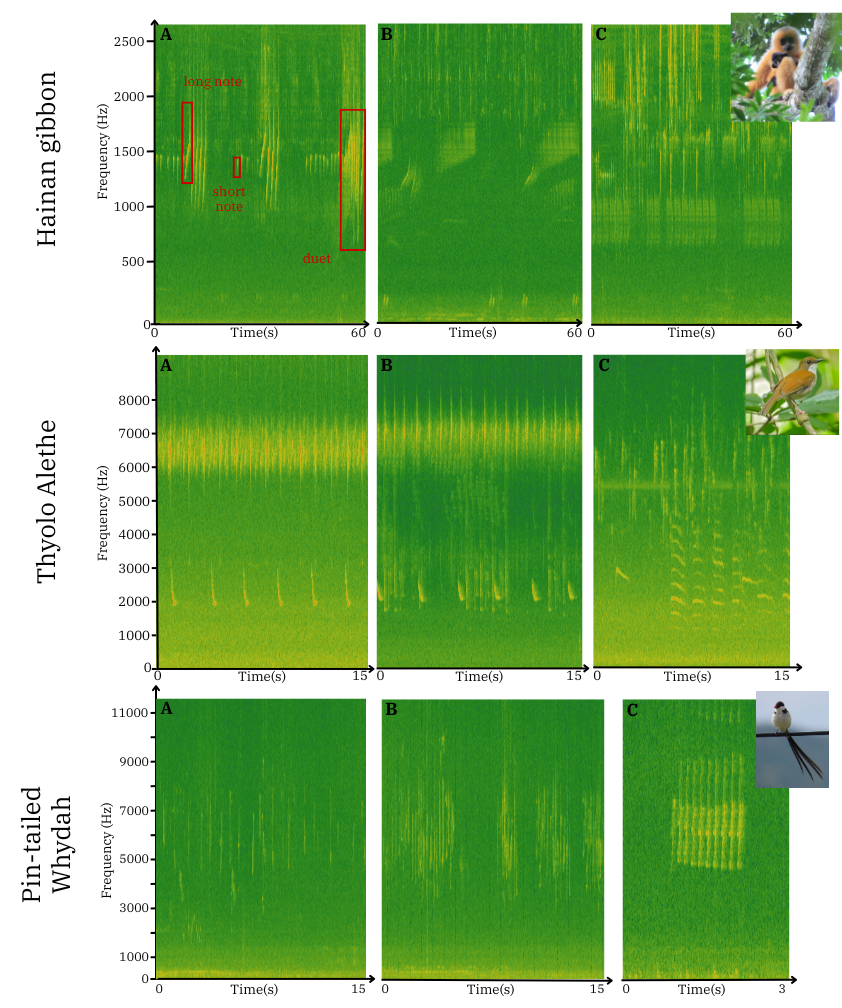
ESO was evaluated on three publicly available bioacoustic datasets that differ in target species, recording rate, soundscape complexity, and call structure.
2. Representation
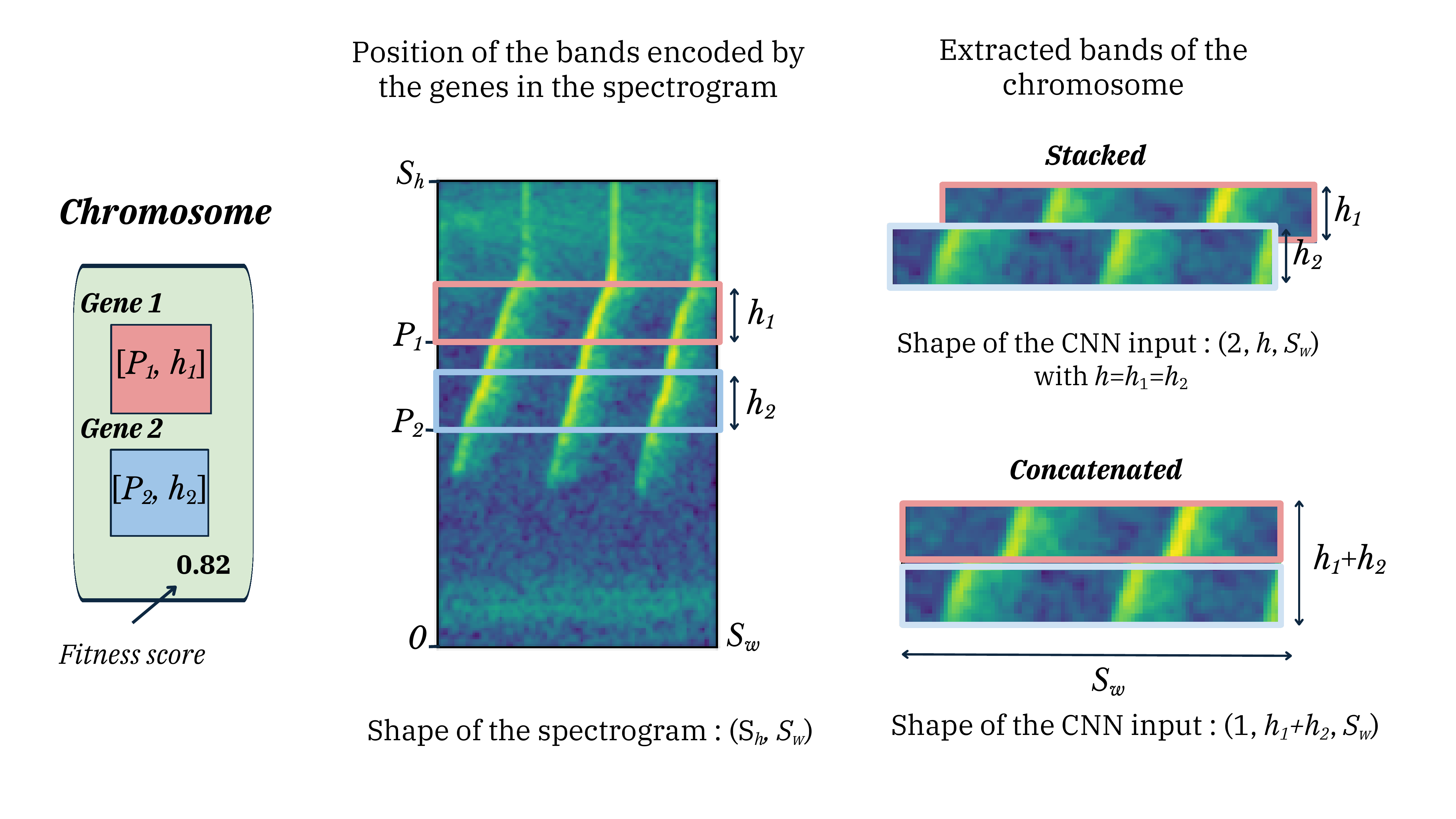
A gene encodes a single mel-spectrogram band by its lower frequency boundary \(P_k\) and height \(h_k\), with \(P_k \in [0, S_h - h_k]\), where \(S_h\) is the mel-spectrogram height. A chromosome is an ordered collection of genes and constitutes one candidate solution.
3. Core abstractions
Five classes cover the algorithm. Each lives under eso/ga/ or eso/model/ and is documented in the API reference.
Gene
A single horizontal band, encoded as a position and a height. eso.ga.gene.Gene
Chromosome
An ordered set of genes and the CNN trained on the bands they define. eso.ga.chromosome.Chromosome
Population
A generation of chromosomes, evaluated and evolved together. eso.ga.population.Population
GeneticOperator
Reproduction, mutation, and crossover with user-defined rates. eso.ga.operator.GeneticOperator
SelectionOperator
Tournament selection. The tournament size is the only parameter. eso.ga.selection.SelectionOperator
Fitness
Relative F1 gain against the baseline plus relative reduction in trainable parameters. Chromosome.get_fitness
4. Documentation
Installation, configuration, and the algorithm's details, with cross-references to the source code.
-
Installation
System requirements, PyTorch wheel selection, and the editable install.
-
First run
Settings JSON template and a minimal Python API example.
-
How ESO works
Pipeline, representation, evolution, training, and evaluation.
-
Configuration
Every field of the settings JSON, with types, defaults, and recommended values from the paper.
-
API reference
Generated from docstrings in the
esopackage. -
Citation
BibTeX and venue.